
Understanding Relationships in Autism: Why Misunderstandings Happen and How to Improve Communication

Updated: Mar 22

Book Launch Announcement:
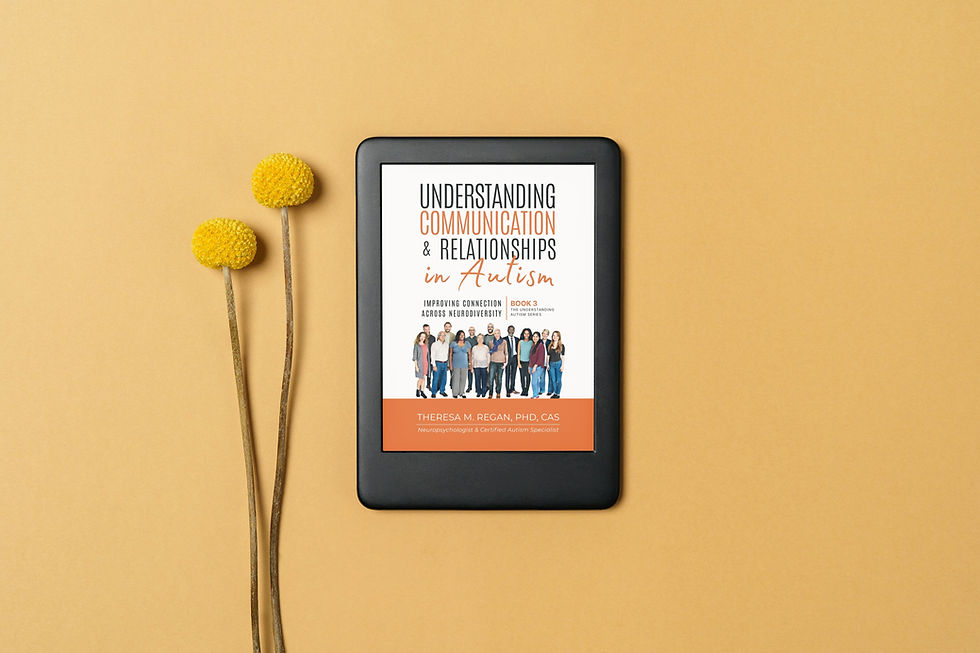
Understanding Communication and Relationships in Autism
I’m pleased to announce the upcoming release of my newest book, Understanding Communication and Relationships in Autism, the third volume in The Understanding Autism Series. The book will be released on April 2, and the ebook is available now for preorder, with paperback and hardcover editions launching on release day.
Over many years of clinical work in neuropsychology, I’ve seen that some of the most confusing and painful moments in people’s lives are not caused by lack of caring. Instead, they often arise from differences in how communication is interpreted. Tone, timing, nonverbal signals, and expectations that seem obvious to one person may be completely invisible to another.
When these differences aren’t understood, everyday interactions can quickly become misunderstandings.
The situations that shape our relationships rarely happen in dramatic or unusual places. They happen in the ordinary rhythm of daily life: in our kitchens after dinner, in classrooms and workplaces, in conversations with partners, friends, colleagues, and family members. A comment spoken while passing in the hallway, the way someone offers help, or the way a gift is given and received can carry very different meanings depending on how each person processes communication.
This new book is an effort to translate neurologically complex concepts into something recognizable and practical for everyday life.
Rather than focusing only on diagnostic descriptions, the book explores how neurological differences in communication and emotional signaling show up in the moments that shape real relationships.
What the Book Covers
The book is organized into three main sections.
1. Neurology, Communication, and Relationships
The first section explores how neurological differences influence communication patterns across both autistic and nonautistic individuals. These differences affect things like timing in conversation, nonverbal expression, emotional signaling, and interpretation of social cues. Understanding these patterns can help explain why two people may experience the same interaction in very different ways.
2. Communication and Conversation
The second section focuses on everyday communication. It explores variations in conversational style across neurotypes and offers practical strategies that help individuals meet their own communication goals while respecting differences in how others communicate. Topics include navigating conversations, understanding emotional exchanges, and building clarity in interactions that might otherwise feel confusing.
3. Relationships
The final section examines how communication differences influence relationships over time. This includes different types of relationships, neurodiverse partnerships, household dynamics, and practical approaches to repairing misunderstandings when they occur. The goal is not perfection, but resilience—helping relationships recover and grow when communication becomes difficult.
Understanding Relationships in Autism: Making the Complex Understandable
The central aim of this book is simple: to make complex neurological ideas accessible and useful in everyday life.
When people understand what is happening beneath the surface of communication differences, something important changes. Confusion often becomes clarity. Blame can soften into curiosity. And relationships can move forward with greater understanding.
This book is written for autistic adults, partners, parents, and professionals who want practical frameworks for navigating communication and relationships with greater confidence.
Release Information
Understanding Communication and Relationships in Autism will be released on April 2.
The ebook is currently available for preorder, and paperback and hardcover editions will be available on release day.
If you’re interested in learning more, the book is linked here:
I’m grateful to the many autistic individuals, families, and colleagues whose experiences and insights have shaped this work.


